Friday, March 28, 2008

It's Friday; It's a Good Thing

Many years ago, before the incarceration and tax scandals, before the monster empires and TV shows, Martha Stewart was the man. You know, not a man, but the man. The one who trumps all. And I don't mean Trump, because that little business venture didn't go over too well. I mean, she was the queen of homemaking. And every woman I knew wanted to be as good as her.

As spring is ripening I am reminded of a spring those many years ago when a fellow teacher, an older, wiser, longer married and very-well-put-together teacher proclaimed to me, "You're just a little Martha Stewart, aren't you?" (My organizational skills at that point were second to none in the classroom, I'd baked and decorated a cake for the entire staff with a feathery-looking stork in a top hat carrying a baby bundle on it in honor of a fellow teacher going out on maternity leave, and spent two weeks in the home-ec room sewing an advent calendar for my sister. Sickening, I know.) It was one of those comments I filed away as one of the best compliments ever.

So in honor of that and Martha's way overused phrase, Fridays are now my time to reflect on what in my life is a good thing.

Here we go.

1. I put my bathroom scale in my linen closet under all my towels two weeks ago and haven't weighed myself since. Scales in a closet are a good thing!

2. I woke up with a mild migraine, foolishly ignored it and went walking anyway, and came home with a raging migraine. I took raging migraine amounts of Motrin and now I am almost fully functional again. Motrin is a good thing!

3. Every morning I make myself coffee, a third of which is skim milk, along with a tablespoon of sugar-free chocolate syrup. It's warm, it's caffeinated, it's low fat and low carb, contains calcium, and fills me up until lunch. Cafe mocha's, made my way, are a good thing!

4. Today I put on a pair of capris from last summer and they fit! This is a good thing!

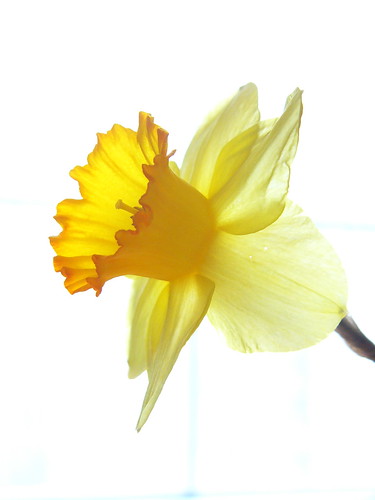
5. Our daffodils are up. I'm not a huge fan of the daffodil. It's not the prettiest flower. The colors are kinda blah, and the yellow is almost impossible to photograph well, and when you cut them they ooze sticky, gooey sappy stuff. BUT: they come out before anything else dares to bloom, braving the real possibility of snow and ice (I've seen many die an early death), to give me hope that summer is around the corner. Even though the woods around are bare, the ground brown and soggy, those sunny flowers are up. Daffodils are a good thing! Happy spring, and happy Friday!

Thursday, March 27, 2008

To Contest or Not to Contest (or: Am I a Sellout?)

BookEnds is having a contest this week here for the first 100 words in women's fiction. I debated whether or not to enter. Firstly, while my new book is well beyond 100 words, it's not even a running start at a novel yet. Secondly, because of that, the beginning may change another 25 times before I decide it's good enough. I tend to rewrite those first two or three pages over and over seeking the perfect way to draw the reader (and, let's face it, agent) in. Thirdly, my first 100 words (not a word more) gave a very incomplete picture of where the story is going. You have to have 123 words to get that. So I did what may have been a mistake.

I compressed.

I took out information I really wanted in in order to gain a better overall view in those few words of where the story is headed. I'm not sure yet it I think that is a sell-out. Should the manuscript an author submits really adequately paint a picture in 100 words or less?

I can see why an agent would tune out if the first 100 words are cumbersome and obviously poor writing, but what if the writing is good and interesting.... don't you get more than 100 words to frame your story?

Most of the submissions to this contest, as well as the other contests that BookEnds has done recently, do this well. Somehow, in the first 100 words there is a tiny story. At the end, I know who the protagonist is, and somewhat of what their dilemma is.

Mine doesn't do this. I thought that I was doing great by getting to the first HUGE problem in the story by the middle of the second page. A great big POW! I-didn't-see-that-coming kind of moment that entirely needs the first full page to set the stage for the POW.

The set-up is this trifecta of breakfast woes: the sausage and gravy biscuits that are causing a heartattack; the milk on the cereal that causes a severe allergic reaction; then the boring but safe bagel that leads to an ambulance trip followed by a helicopter trip followed by a diagnosis that changes their lives.

But 100 words barely covered the sausage gravy thing, and that itself didn't seem enough. So I clipped, chipped, rearranged, and in the end got 123 words into 99, and I feel like I lost a little something in the process.

I don't really think I'll win, so maybe the point is moot. But in not winning I'll wonder if it's because it's not what I would actually submit or if it's just not good enough to begin with.

For what it's worth, here is the "real" beginning, what I would have posted had I been allowed a few extra lines:

I’m no killer, but if I was, my family would say my MO is death by breakfast. During Travis’s mid-life physical, his doctor informed him my daily eggs and sausage gravy on biscuits was drivin’ him to an early grave. He handed me the lab results, claiming Travis’s LDL numbers were higher than a crackhead. I said if a crackhead had my sausage gravy he’d give up the crack and rather die of plugged arteries. He didn’t laugh. We switched to eggs and toast.

When Logan was young enough to run around bare-tushed, he developed hives and a propensity for up-chucking. His pediatrician pointed to the milk we poured on his Cocoa Crispies each morning. Who the Sam Hill is allergic to milk, I asked. We switched to PopTarts and apple juice anyway.


But bagels and orange juice were the ones that finally done us in. ‘Course, they were white bagels, not those whole wheat ones with all those grains in them, and they were slathered in butter and honey. And the orange juice was really Sunny D, which I know is mostly water and corn syrup, but it’s got all that vitamin c in it so it must be some kind of healthy. Besides, it was all I could get Ashley to cram down before trying to catch the bus each morning. She got her late genes from Travis.


So there it is. Now time to go do my real writing.

Monday, March 24, 2008

Keeping the Possums Out of the Persimmon Patch (or: The Plot Thickens)


This is the book that belongs on every writer's shelf, or, in my case, in my laptop bag (we are having shelving issues at my house, but that is entirely beside the point).


I first checked this book out of the library, when I went searching for the drool-worthy titled book, The First Five Pages, and instead found this one. I sat to read it like I've read other writing books but quickly found myself reaching for a pen ("I've got to write this down! Oooh! This too!")

In no short time I was bent over my table, book in one hand and pen in the other, taking notes like the studious college kid I was. Pages later, I decided, I need to buy this book. If it tells you anything at all, I actually went to a real bookstore and paid retail for it. It's that good.

I thought about going through the book and summarizing it, but I'm short on time, and if you pick up the book at your local library, perusing the table of contents and the subtitles in the chapters will actually give you a great overview. In fact, it is so practically and logically laid out, you can really use it as a resource book instead of just reading through it, flipping here and there to find the specific help you need.

I will highlight for you the greatest insights I gained, though.

The first few chapters of the book focus on characterization, which seem to bump against the title of plot, but which is the perfect way to start, since, in my mind, characters really drive the plot.

Noah Lukeman spills a plethora of questions onto the table, mostly as a series of checklists of things you should know about your character. Looks: height? hair and eye color? scars? age? clothing and accessories? He recommends you take a look at this character through the eyes of a doctor, a police sketch artist, someone setting their friend up on a blind date with the character. What you end up with is a complete picture that also tells something about who your character is (she wears designer label pant suits and a rolex. without another word we know she is concerned with looks and cares, at least modestly, about opinions, likes quality things, and probably has some money).

Also asked: what is the character's medical background? their family background? where does he live? what pets does he own? what would a psychologist say about him? a banker? an ex-girlfriend?

As I read through this book it was so hard not to go back and fix the things in my first novel that could have been fixed. I understood Stephen King's statement that the first draft we write for ourselves, then we cut most of it out. On my first novel I included so many details about my character that probably didn't need to be told. This time around, I started by doing this character exercise with each of the main character. I wrote a one-page bio about each one. Before I even started my writing, I had a fantastic concept of who my people are, where they come from and what they want out of life; how their past influences who they are and how they react in crisis. And now, as I write, I can let their reactions and their words come from that knowledge, without having to create that knowledge on the page for the reader.

Yeah, it help me to know that my matriarch main character was the first born in a family of five, and that she dyes her hair because she doesn't want anyone to know she's starting to gray just a little, but will I put that in my book? Probably not. But it definitely influences how she runs her family and relates to her friends.

(As an aside, I totally get the whole gay Dumbledore thing from this perspective. I don't want Dumbledore to be gay, and when I read Harry Potter, I never got that from the writing. But, now that I know Rowling had that in her head, I can see how she created his choices out of that knowledge. We as a reader didn't need to know why he wasn't married, or why he dressed eccentrically, even by wizard standards, but by Rowling knowing it, it helped her to capture the nuances of his character better.)

This book also covers a great deal in how to build suspense and create good conflict, not just in the outer actions that may drive the plot, but in the development of the characters and the internal journey they take. He makes a great point that in good books, the character at the end of the book is not the same as the one at the beginning. He must change because of what ensues over all those pages.

I could keep writing, but in essence, go get the book. You won't be sorry.

As for me, I have now started actually writing my own novel, and so my blogs will probably lessen in frequency, and certainly in substance (if that's possible). It's back to the grindstone!

Sunday, March 23, 2008

Happily Ever After

In the past week I have devoured three books, all by Emily Giffin. I'm not typically a "chick lit" reader, so I wondered why these books I absolutely couldn't put down. (Two of them I read in less than a day, which is a feat considering all three kids were home on Spring break)

I realized, as I found myself actually smiling one of those silly, ear-to-ear smiles at the end of the third, it's because I've become a fan of the happy ending.

When I was in college writing classes I made my name as the "sad but real" writer. While everyone else wrapped their stories up with neatly packaged conclusions for their characters, I left things hanging, often morosely. I wanted to write what I saw as seriously lacking in the books I was reading: reality. If a child is being sexually abused by her father (my first short story), she isn't going to just tell the first available sympathetic ear and be all better. In the end, she kept the secret, because she didn't know how to ask for help. I think it left my readers a bit unsatisfied, but it earned me a lot of respect.

Perhaps it's because I have kids now, and I want happy endings for them. Maybe it's because I can hardly watch the news anymore without feeling a gut-wrenching sadness for the lives of so many others. People on the roads are angry. People in the stores are frustrated and short-tempered. Children are beaten. Women are abused. Leaders in powerful positions all over the world are evil. This is the world I am raising my children in, sending them out in.

But I am happy. I am unbelievably content with my blessings, and unperturbed by my lack. I smile and laugh with my daughter as we shop. My kids and I crank up the music in the car and sing along to it. We dance in the kitchen. I want the happy endings.

Lately, I've read a lot of books that leave me in a funk. Great writing. Great story. Can't put it down kind of stuff. And then for days I walk around in a funk, letting the finality of the story weigh on my mind. I wanted better for the characters, and I feel sad they didn't get a better end. Or worse, I end up not liking them, which is the worst of all because I wonder why I spent valuable time investing in people I wanted to care about only to find out they really had very few redeeming qualities and deserved what they got.

I get it. I do. I used to write like that too. And if you are one of my writer friends, and you write a book like that, I will understand and I will read it, and probably love it because you wrote it and it's your baby.

But for now, I am relishing in these fun reads, where the characters are likable, and find their perfect end.

I like the fairytale, happily-ever-after after all. Who'd have thought?

Friday, March 21, 2008

Texasisms (or: If promises were persimmons, possums could eat good at my blog)

I know I promised I'd write about The Plot Thickens by Noah Lukeman today - and I just bet you were waiting on pins and needles for that one - but I have other things on my mind today that I thought I'd share.

If you've read any of this blog lately you'll know I am in the process of researching my next novel, writing bits and pieces of it, but mostly still in the forming stages.

I thought I'd tire quickly of this. Not that I don't love researching; I absolutely love researching. I watch TV with my laptop on my... um... lap, so that I can look up actors to see what else they've been in; fact check; learn more about some topic briefly touched on that piques my interest. I love researching. Just not when it takes the place of writing. It seems like I am just spinning my wheels here waiting to know enough to write.

But lately, I am in love with it. I bet now you are on the edge of your seat wanting to know why. Let me tell you.

My story takes place in a small Texas town: one of those towns where many of the roads are still mostly dusty and barely paved, where old men still hang around the barber shop and play checkers, and church socials are the highlight of the week. These places exist. I know. My husband used to get his hair cut in one of those barber shops not many years ago.

So this week I am taking a metaphorical trip back in time to find my Texas roots, and I can tell you this: there are very few places and people and cultures that make me smile the way Texas does. They have their own kind of food, their own kind of celebrations. You can attach the word "fest" at the end of almost any word and add a ferris wheel and pow! you have a Texas celebration! Try it: strawberryfest - in Poteet; Mosquitofest - in Clute; wurstfest - New Braunfels; chilefest - in San Antonio. I've been to most of them over the years. The strawberryfest was so dusty I couldn't ever see the tables of strawberry wine through the dustbowl-like conditions. The chilefest was my first, and last thank you very much, experience with jalepeno peanut brittle, which hast to hail from hell itself.

But the best part of Texas culture is it's language. Ifn you ain't from therebouts, you probably reckon they speak English there. You'd be wronger than a pig walking into a bar-b-que. Here are some of our family favorites, even after moving away ten years ago:

  • He's busier than a one-legged man in a butt-kickin' contest.
  • You look more nervous than a long-tailed cat in a room full of rockin' chairs.
  • Slicker than snot (as in, after that last gully-washer our porch stairs are slicker than snot)
  • Well, you'll have that...(a great way to get the last word in the conversation if you don't really have anything intelligent to add)
  • Knee high to a grasshopper (do I need to explain that means young?)
  • Older than dirt
  • He's all hat and no cattle
  • white on rice (as in: did you see that new guy at church? He was all over Becky like white on rice! Or: Did you take out that trash like I asked? Yes'm, I all over it like white on rice.)
  • We've howdied but we haven't shook (this is relevant way more than is appropriate to use it, since you sometimes gotta watch who you're talkin' Texan to outside of Texas)
But in researching I've come across others I've either forgotten or plain didn't know.

  • She took to you like _______ (fill in the blank: buzzard to roadkill; sticker burr to bare feet)
  • It's so dry the trees are bribing the dogs
  • Confused as a cow on astroturf
  • Lower than a snake's belly
  • Higher than a Georgian pine (drunk)
  • He's only got one oar in the water
  • Madder than a wet hen

As I've tried to get the voice of my characters, more and more of that Texas talk is coming to mind, and it occurs to me that Nathan Bransford might curl up and die there in Texas with all those great similes that are the mainstay of conversation. (Curl Up and Dye was, by the way, where I went to get my hair cut). And honestly, one of the greatest challenges of this book is getting the voices right: balancing the voice of real Texas talk with the tolerability level of outsiders. If I actually wrote the book through the eyes of the main character in this kind of language, it would drive the readers mad. Mark Twain might have been able to pull off that kind of narrative, but I'm not kidding myself. A little goes a long way. The great thing is that, despite the very serious side of the topic of the story, these colloquialisms lend a certain amount of levity to an otherwise heavy topic, and the add color to the cast of characters. I think my last book missed some of that.

Sometime I'll blog about the parents I've interviewed as well. I've gathered enough stories about kids being diagnosed with diabetes to fill a book of its own, and they are so heartwrenching and touching and uplifting they each deserve their own say. I am blown away by the generosity and openness of people to tell me about their experiences and their fears. I'm glad I have type 1 and not my kids, but for the next year or so, I'm going to have to crawl inside the mind of a mom who wishes she had it instead of her daughter. It's not enough for me to just try and imagine, because who among us really can know unless it's actually happened. So thank you to all those moms and dads who filled me in what went through their minds and how their lives have radically changed. You guys are awesome!

I'm so excited about this I could spit!

Thursday, March 20, 2008

Some of the Books I've Read Lately

After putting away my completed manuscript and starting the process over, I've been reading a lot. Some of it is research for the new book. Some of it is pure fun disguised as "let's see what's selling now." And some of the reading is about fine-tuning my own writing.

It didn't take long to stumble over Noah Lukeman's writing. I think I probably was first wooed by the alluring title, The First Five Pages: A Writer's Guide to Staying Out of the Rejection Pile. Who doesn't want to stay out of the rejection pile? And having had several requests for partials that all ended with something like, "Your premise is really strong. I really like the idea of this but the narrative just didn't grab me right away," I want to know: how do I make those first five pages irresistible?


I don't think this is a bad book. If you are a new writer, or have faced lots of rejections and have no idea why, this might be a great place to start. But I was hoping for more. Maybe I wanted the secret that would suddenly have agents phoning me at 3 am saying, "I've got to have this!" Maybe I wanted something concrete that would make me smack my palm against my forehead and say, "That's it! That's what I was missing!" And maybe I wanted that formula I could plug and play.

Whatever it was I wanted, it wasn't what I got. What I got was a list of don'ts that I already knew, either from writing classes or from scouring the web for writing advice or from Stephen King's On Writing. It included such advice as make sure you don't have lots of spelling errors and use correct formatting, and please, please, send clean, unwrinkled copies. Check.

Eliminate excessive adjectives and almost all adverbs. Check.

Use correct punctuation. Check. Well, mostly. But the wrong stuff is limited and meaningful.

Get rid of extraneous characters and subplots. Check.

Similes and metaphors are evil.

The purpose of dialogue.

It's not that this stuff isn't good. It is. It's important. Imperative. Not just for the first five pages, but for the entire manuscript. And that's what this book is. A guide for making your manuscript not stink. But as for the first five pages, the way to make your partial stand out and scream, "read me! read me!" it doesn't offer the magic pill. It's more don't do this than do this. It's more this will get you tossed immediately than this will make them ask for more.

I think this book is good, but the title is misleading. The information is adequate, but not enough to propel a good writer into the arms of an agent. It is well written; it is clear and well organized; it is practical. I'd even go so far as to say I think aspiring writers should read it. But the way to catching an agent it ain't. And for that fact, I was a bit disappointed.

Tomorrow: The Plot Thickens (also by Noah Lukeman): I loved this one!