Weronika posed this question at her blog today, along with two essays by famous writers who answered that very question. Weronika's challenge for those of us who write was to answer the question as well.
Why do I write?
I know so many people who say they write because they have to. I wonder if it makes me not a true-heart-writer that this isn't true of me. I've spent most of my life writing in some form or another, I guess. Middle school and high school I journaled nearly daily, with much poetry thrown in for good teen measure. And in college I took so many elective classes in writing that I ended up with an "option" in it.
But there have been years where I didn't write. Not short stories, not poems, not even journals. I was too tired. Too up to my eyeballs in spitup and diapers and scraped knees and playgrounds. There were years where the highest level reading I accomplished was "Good Night Moon" and "How Much Do I Love You," read over and over and over until I was speaking them in my sleep.
Those years, I didn't write. So I know it's possible not to write.
So why do I write? It isn't for the money, for sure! It isn't for fame or notoriety. I'm actually more comfortable letting people assume I'm a stay-at-home mom with no other vocation than to speak up and say that I'm a published author. I don't have characters talking to me in my head until I've already well-pushed them down their plotline. I don't write for catharsis. It's not always fun. It's often hard.
I do have stories flitting through my head constantly. I see people and wonder what makes them tick. Where are they off to? Why are they smiling that way, or mad at the world? I read news articles and think how I could develop it into a novel. When I read books, I think about how, with a single small change the entire story could take another turn.
And yet I don't write most of those stories.
So I found myself asking today, why in the world do I write?
For one, because I love it. Even when it's hard, or when it's not fun, I love it. There's few things I'd rather do than sit and create stories and watch characters evolve. In a sense, it's like creation. Yesterday there were no people... today there are. I make up towns and coffee shops and conversations that are so much more elegant or snappy than ones I can have myself. One a story gets started, for me, it becomes a sort of reality, as if those characters are real people who I can care for and love and worry about. So even though I don't need to write stories to live and breathe, I do love it.
But I think even more the question for me is not so much why do I write, but why do I write what I write?
I write what I write to make a difference to people. To let someone know they aren't alone in their experiences. To make people see a new perspective, to see something from another point of view they might not otherwise see. I write with the hopes that people will talk and debate and have conversations about what they've read. It doesn't matter if you agree or not; but that it makes you think.
There was a point two years ago, before I sold my first book, when I said to myself that I didn't care if I became a huge success or sold a lot of book or made enough money to buy a bottle of champagne to celebrate that milestone. I just wanted to make a difference to one person. If I changed one person's life, if I made one person stop and think and feel like they were understood or suddenly understood someone else, then that was success to me.
Today, when considering this post, I wondered if that was enough anymore. I've had readers write and tell me I did make a difference in their lives, and there's nothing better to hear for me. But still.... if I don't sell a certain amount of my debut book, I won't get another publisher willing to take a risk on another book. It's important to sell books, and write books that sell, not just for me but for those people who invest in the process as well: agent and editors and publishers need to do more than make a difference in one person's life. They need to make money; and as an author, my job is to help them do that. So, my own version of success could mean ultimate failure.
So is it enough? Is making a difference to one person, and then letting the dream go, enough?
And if I say it is, does that mean I'm not a true writer in my soul? If I can be content with following another career path should things not work out, does that make me less ambitious? Less deserving of that publication?
I can't imagine not writing right now. But I'm hoping also to get a masters degree that will allow me to teach at the college level, or be an editor, or do something to do with writing and books that doesn't just mean creating my own stories.
In the end, though, I'm a fairly content person. There's very few things I need: God, my family, basic survival necessities like food and a shelter. So do I need to write to keep living and breathing? No. But I sure do love doing it, and as long as I am able to make it a priority, I will.
Wednesday, September 15, 2010
Sunday, September 12, 2010
Drama on the Hallowed Ground
There are lots of places in life where drama is expected. "Reality" TV shows, for one. Weddings. Protest rallies and radio talk shows. Blogs even. I've certainly seen my share of blog drama, words flying so fast and angrily in the comment section you can practically feel the spit flinging out of the screen at you. There was, in fact, a blog post this weekend that had me grinding my teeth with my itchy fingers poised over the keyboard ready to step into the fray.
But I didn't. I didn't because the post wasn't written in such a way as to say, "Hey, why don't you share your opinion and lets openly debate and discuss this issue." It was written with one fist raised in a "I dare you to disagree" way. And lets face it, I'm just not that into controversy.
So it really set my teeth on edge when someone came gunning for me, ready to start a war on my hallowed safe ground: my facebook page.
Honestly, folks... don't we choose our facebook friends? Isn't the point of being selective so that you are surrounded in that little piece of real estate by people you actually like? How many places in life can you do that? Facebook should be a safe haven.
So when a supposed friend came at me – and all my other friends – with rude and snide comments, I was a little shocked. Especially over the topic at hand.
Was it politics? Religion? My choice of Nikon over Canon? My occasional mention of Justin Bieber?
No. The offending status update was over this:
This is a pool. It is my pool. Well, not mine, per se, but the pool my family belongs to. It's on an Army post, at an officer's club. My husband used to be an Army officer and now works for the Department of Defense, which gives us certain very limited access to post facilities, like the O-Club.
The status update wasn't even about the pool. It was about a welcome-home-Daddy sign I saw on the lawn of one of the houses I passed leaving the pool. It was a sweet, sweet sign that made me tear up.
Apparently, this is offensive.
I go to a pool that should only be for officers.
A question was asked rudely, which I answered politely. Others chimed in on the answer, and the rudeness on the "friend's" part escalated. I made a joke to diffuse the situation and it got even uglier. Other friends tried to make a joke of it. It got downright hateful. I had friends writing me personal emails, "Who the heck is this girl and where in the world does she get off saying this stuff to us?"
This isn't the first time I've been treated combatively by her before. Anything I write seems to set her off. And the sad, sad fact is that this isn't some random person I met over the blogosphere. This is someone I've known. Someone who's house I've stayed at, who I've made dinner for and vacationed with. Her husband was in our wedding party. And yet, it's as though I don't know her at all. This is not the person I once was friends with.
But to criticize me and be snide with me is one thing. When she went ballistic on my friends, that was the end of the line for me.
So for the first time in my facebook life, I un-friended someone.
There was immediate hateful kickback, and then all went silent.
Blissfully quiet.
This kind of quiet:
Because life is too short to surround yourself voluntarily with people who try to make your life miserable. And if facebook is the only hallowed peaceful ground I have left I can control... I'm going to exercise my right to make it drama free.
I'll leave the drama for the new season of Survivor.
Saturday, September 11, 2010
Remembering 9/11
It's been nine years since the terrorists attacked the U.S. It's hard to believe my kids have never really known a pre-9-11 world. They are asking questions now, especially my youngest, like "Were the people on the planes scared because they were flying into a building?" "Why didn't the firemen just spray water on the fire?" and "If people jumped out a window, was there a fountain on the ground they could fall into, like in front of Daddy's old office?"
It's natural, I suppose, that most of the conversation revolves around New York and the twin towers. We've been there and seen the hole in the ground and the building around it being reconstructed. We've been in the fire stations and the TV shows focus on that event. My husband used to work there, and was on the top floor when the bombing of 1993 occurred. So there is connection.
But we live in D.C. now, and we know people who were in the Pentagon. We pass the building often, hardly noticing anymore how it's been fixed, one wall slightly whiter and smoother than the others. Unlike the Ground Zero area, the Pentagon rebuilt quickly and moved on.
For a few years after moving here, we participated in a "Freedom Walk" on September 11. It wasn't a protest or march or anything political. People of all faiths, political points of view, and ages gathered in the shadow of the Washington Monument and walked through D.C., by the Lincoln Monument and across the bridge, by Arlington Cemetery and over to the Pentagon, where a flag was draped over the section of wall that the airplane had taken lives. We were all Americans. We all loved this country.
When Obama became president he canceled the 4 year tradition. He said it was the former president's thing, and we could no longer organize. Funny thing, it wasn't even organized by the president. It wasn't mandated by him or suggested by him. It was organized by a group in the Department of Defense that supports the military and their families.
I miss it.
Anyway, today I remember. Everyone has a story about that day. If you'd like to share, I'd love to hear yours.
Wednesday, September 8, 2010
Snapshot of an Addict
At this moment, I’m sitting in my car in the pitch black, half-way down my long driveway, mooching internet off a neighbor. I have, in the past 36 hours, stood here, jumping on one leg and batting away the mosquitoes that hover around me like they know my blood sugar is high, just in an effort to download my emails onto my itouch. Occasionally I’m ashamed I’ve yelled at the itouch: “Download, you stupid emails!! Download!” It’s times like this I wish I’d gone ahead and admitted my addiction and gone for the full-blown iphone with connectivity anywhere.
I am here because yesterday morning, our neighbors (from whom I’m mooching) had Comcast come bury a cable that had been lying across our driveways for four months. When they arrived, instead of waiting for the guy who, as is required by law, comes to mark all power and telephone lines, they dug huge ditches anyway. And snipped our lines in three places. And as we have DSL, no telephone means no internet.
They shrugged and told me to call the phone company, which I did. Of course, I couldn’t call on my phone line because that was dead. And my cell phone battery was nearly dead as well. So I had to plug my cell phone into an outlet. This wouldn’t be a big problem, except that we live in the woods and there are only a few spots where we get phone reception in the house. None of those spots are near an outlet.
So I call on the almost dead cell phone with spotty reception, and go through a 15 minute computerized answering service that tries to diagnose a problem I could tell live person in 2 seconds. The computerized voice tells me that if I wish to speak to a representative, I can say “agent” at any time.
The conversation with the computerized person went something like this:
CP: If you’d like to speak to a representative, you can say “agent” at any time. Is your phone receiving a dial tone?
Me: Agent.
CP: I don’t understand. Would you like us to run diagnostics on your phone line?
Me: Agent
CP: Running Diagnostics.
Me: Agent! Agent!
CP: I don’t understand. Running diagnostics. Just a minute more.
Me: AGENT!!
CP: I can’t tell if the problem is in your phone or in the phone lines. Is there more than one phone in the house?
Me: AGENT!! AGENT!! AGENT YOU IDIOT COMPUTER!!!
CP: I don’t understand.
Me: hanging up now.
I call back. It only takes me yelling agent four times before the computer finally says, “I think you said you wish to speak to a representative; is that correct?”
So I get the representative who isn’t particularly friendly and tells me since Comcast did the damage I won’t be responsible for the charges to fix the lines (at which part I start seriously rolling my eyes at her) and that they can come out in three days.
At which point I nearly fall apart. I’m pretty sure I sounded like a drug addict when I panick-ly tell her I can’t possibly go without internet for three days.
When I finally calm down and realize no amount of crying and begging is going to get someone here any faster, she finishes getting the information and then says, “So the technician will call you when he’s on his way. Is this account number the best one to reach you at?
Me: Ummmm….no. The account number has no dial tone. The phone lines are snipped. Remember?
Her: Oh, well, then, shall we send you an email?
Me: NO!! I can’t get internet, remember? Thus my previous meltdown!
Her: Oh. Well, they’ll be there when they get there, okay?
Me: Okay. I’ll be home… standing in the middle of the driveway mooching wireless from my neighbor and smelling of bug spray.
Her: Okay. Have a nice day.
So, dear blogging buddies, I haven’t see your posts or written back to your lovely emails, but I am hoping tomorrow it will all be better.
In the meantime, I’m getting monstrous amounts done since I’m not on the Internet. I’m not happy about it, but I’m getting it done.
Monday, September 6, 2010
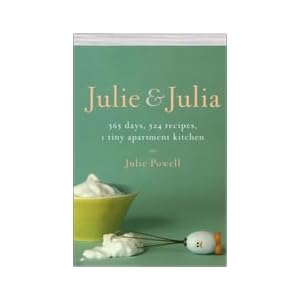
The Julie/Julia Project: A Book, Movie, and Inspiration
If you dropped by thinking you were going to get a book review, you're wrong. Well, partly wrong. Partly, because I haven't even finished the book yet, alhtough I'm a mere whisper away from the end, and I'm not even sure what to say about what I've read.
Anyone read this book?
It's a memoir. In case you're one of those who hasn't heard of the book, or at the very least heard of the movie staring Amy Adams and Meryl Streep, the book is about a woman named Julie who, in a state of depression and frustration, decides to turn her life around by cooking through the entire Mastering the Art of Fine Cooking by Julia Child.
She began the Julie/Julia Project in conjunction with a blog... this being in the days before blogger and livejournal and the onslaught of blogdom. And by half way through the book, I wish I'd just read the blog instead of the book that it's based on.
I'm conflicted, so far. It doesn't read like a story, which maybe is a hallmark of a memoir. It's sort of chronological, but then again, not really at all. There's not really a plot, save the cookbook, which isn't exactly plot-rich. There are relationships: her husband, her brother and parents, a few stray friends, a business colleague or two mentioned by name, but none of these characters very fully developed. They pop in here and there but without purpose other than to serve food to. As a person who writer, and reads, to get to know characters, this bugs me a little.
Despite what the movie might allude to, the book itself features almost nothing of Julia Child herself. There isn't the grand flipping back and forth, and the only little snippets you get of Julia's life are before she really learns to cook. I think what I'm learning in the book is that I want to read a book about Julia Child.
The writer herself isn't that likable, either, which is hard to say because since she wrote the book and it's about her, shouldn't it make her to be likable? Does that mean she's really self-deprecating, a quality that usually balances out most other faults? But I don't think she is. I think she's just opinionated and critical and judgmental and a bit bitter, and unafraid to admit that. And some of that rubs me the wrong way. Others who agree with her might not find it grating, though. I found it interesting how endearing the movie made Julie: weepy at the 9/11 calls, bonded with co-workers, either happy or sad, but rarely bitter and angry in an ugly sort of way; this is not the Julie of the book at all.
Still, I find the book unputdownable. There is something about a memoir that forgives a great amount of lack, because it's real, and because you as a reader know it's real. I'm intensely interested in people and in their lives (hence my DVR schedule of reality TV). I like people watching, and so a memoir is that. And Julie writes in such a way that makes you feel as though you are getting to watch her as she goes through her days. Not the high points of a life, the awards and political appointments and dramatic moments of a celebrity memoir, but the minutia of the day-day-day we all struggle with, and her unique way of dealing with it.
I will say there were chapters that gave me nightmares. I woke one night this past week feeling queasy and sick and ran to the bathroom. My head pounding, the tile cool against my cheek, all I could think of was aspic. The mental image of making aspic, the smell of aspic, the color of it and the way it jiggles in the pan, of blue eggs soaked in red wine resting in the middle of it. And I realized I'd been dreaming of the chapter of eggs and aspics, and it had made me literally sick.
I slunk back to bed, still feeling ill, and hoping in the morning I, like Julie, would turn the chapter on that and head into something better and more tasty.
I don't think reading Julie and Julia would be especially inspirational to most people in the area of the art of mastering French cooking. I've heard great things about French food, but after reading this book, I certainly don't feel like eating it. The recipes she chose to include in the book, I can only surmise because they are the most dramatic, are ones which include calves feet and creamed livers and bone marrow. I want to know more about Julia Child, but I don't care to pick up the cookbook!
Still, motivation still comes because I love cooking, and because the cooking itself, while seeming to drive Julie and her husband to madness, is also her salvation and sanity. And so, the book buzzing in my brain, I decided to bake scones for my childrens' teachers on the first day of school.
I've only baked scones with Bisquick before, so I hunted the most complex recipe with five stars I could find on google, gathered supplies, and set out to be my own Julie/Julia.
I didn't save my life through them. I didn't find myself or make my miserable life less miserable. I didn't accomplish any great feat or gather media attention or get a book deal or garner tons of dedicated blog readers through it, but I did make delicious blueberry scones. And today I think I'll try orange and cranberry, and some chocolate chip ones.
Because, while Julie the blogger/author would move on to the next recipe, a deadline in hand, I have all the time in the world to perfect and hone my scones. And I think that's exactly what Julia Child might do.
** Okay, I finished the book, and near the end there are maggots. MAGGOTS!! Oh yeah, like I won't have graphic nightmares about that description. So after thoroughly cleaning and cloroxing my own kitchen, I set about keeping the nighttime nausea at bay by slow cooking ribs with steamed broccoli and mashed potatoes. I knew that Julie and Julia would know what to do with all those juices in the bottom of the ribs, whipping it together with butter and cream and mushrooms and onions and artichokes and other things I can't even remember to make some delectable gravy. I, however, am not Julie or Julia, so I threw it away. And made more scones.
Wednesday, September 1, 2010
Language and Violence and Sex... Oh My.
I ran across a blog post by Nathan Bransford last week that got me thinking. In it, he quoted from another post by a woman named Sheryl Cotleur who raised the issue of violence in young adult books. In particular, she referred to the latest book in the Hunger Games Trilogy by Suzanne Collins.
I have to preface the rest of this with saying that I haven't read the Hunger Games books yet. I have the first two, but somehow always find other things that top my list. I'm not a YA author, so the types of books that pique my interest aren't usually YA. So while I haven't read the books, I'm not able to speak specifically towards the appropriateness of the violence in them for younger readers.
What the remarks by both Sheryl and Nathan did make me think about was the broader subject of what's appropriate for young adult, and even middle grade and children's books. I've been thinking about this for a while now, my own son and daughter entering the age and reading ability that brings them into the YA realm. And having read some of these books, let me say it scares me.
I freely admit to being restrictive to what my kids have seen in movies and read in books. I'm sure you'll find it shocking that I was uncomfortable with the "torture" sequences in the Pixar film "The Incredibles." I'm not one of the parents who think their child is going to be exposed to sex and violence and language and alcohol in the world around them so why protect them. I protect them so that they are shielded from that for as long as possible. There will be a whole lifetime ahead of them to be exposed to those things. And being exposed is very different from presenting it to them as acceptable. I don't care what the world around us says: sex and drinking and cursing are not appropriate for a 12 year old, let alone a ten year old. At least not for my kids.
Finding language in a book aimed at kids that would make a movie rated R disturbs me. I've read other blogs and the litany of comments over the last year, so I know this puts me in a minority. I know YA authors find parents like me unreasonable and idiotic. Last year I sat down with a stack of YA books I hoped my daughter would be interested in reading in the next few years, and I was dumbstruck by the amount of casual sex in it. It wasn't even like Forever, the Judy Bloom book that is entirely about sex, which treats it as something big and significant to dive into. This was total casual sex. By fourteen year olds. In books aimed at 12-16 year olds.
In my own little perfect world books aimed at kids under the age of 16 wouldn't have any of this, but I know this isn't realistic. There are enough people out there yelling about the rights of authors to write what they want, and for kids to read what they want, that I'm fairly sure the tides are not going to turn back towards innocence.
Still, why not a rating system for books? If authors insist on writing with certain amounts of violence or language or other material that parents might object to, and parents continue to object (which there actually are some of us), why not just rate the books the same way music and movies and video games are rated? That way a parent – or a teen, even, as I do know some that don't want that in the books they read – can make decisions before they choose.
I know this is controversial. I've googled "book rating systems." Go ahead and try it. It's vicious out there. People think it's tantamount to censorship. They think books are already adequately labeled just by putting them in the middle grade or YA category (which I can promise, by reading hundreds of these books, does not mean they are clean of what might concern some parents). I've read many, many of these articles and arguments, not a single one of which addresses the real concern of parents and teens, or does so in a way which dignifies their point of view. There's not a single argument against the rating system that I could find that I couldn't logically rebut.
I suppose there's a part of me that's flummoxed why authors would be so angry about this. Is it because they don't want parents to know what's in their books? Is it because they're afraid they'd lose readership? Is it because the surprise of finding questionable content and the resulting outcry generates free publicity for them? If an author truly thinks sex and language and alcohol use among teens is common and unremarkable, why should it bother them if that's listed on the book cover?
As for the violence in the Hunger Games that started this discussion on Nathan's blog, I think it's still a matter of content and context and information. The holocaust is a horrific event that would no doubt draw a less-than-G rating, but even so there are middle grade books that address the topic gently and carefully which even cautious parents would consider. The point is that in knowing what's in the book, those parents who care can use those books as springboards for discussion and kids with squeamish stomachs can choose something else.
It's not about censorship; it's about being able to make informed decisions. I remember when the music industry first began dealing with ratings, and there was an uproar then. Now... who cares about it? There are still 5-year-olds out there listening to rap music with language that would make a sailor blush. That's their parent's choice. And parents who choose otherwise, choose something else. Is that so bad?
So my question is this: What's your opinion on a book rating system for middle grade and YA? And do you think it would change the way writers write?
Subscribe to:
Posts (Atom)